Why Waiting for the Retest Improves Win Rate
The claim is true and it is also incomplete. Waiting for price to return to a broken level does raise the proportion of trades that work, for reasons that are mechanically clear.
Why waiting for the retest improves win rate is the easy half. The harder question is whether a higher win rate leaves you with more money, and that depends on a number most traders have never measured.
Why the Win Rate Rises
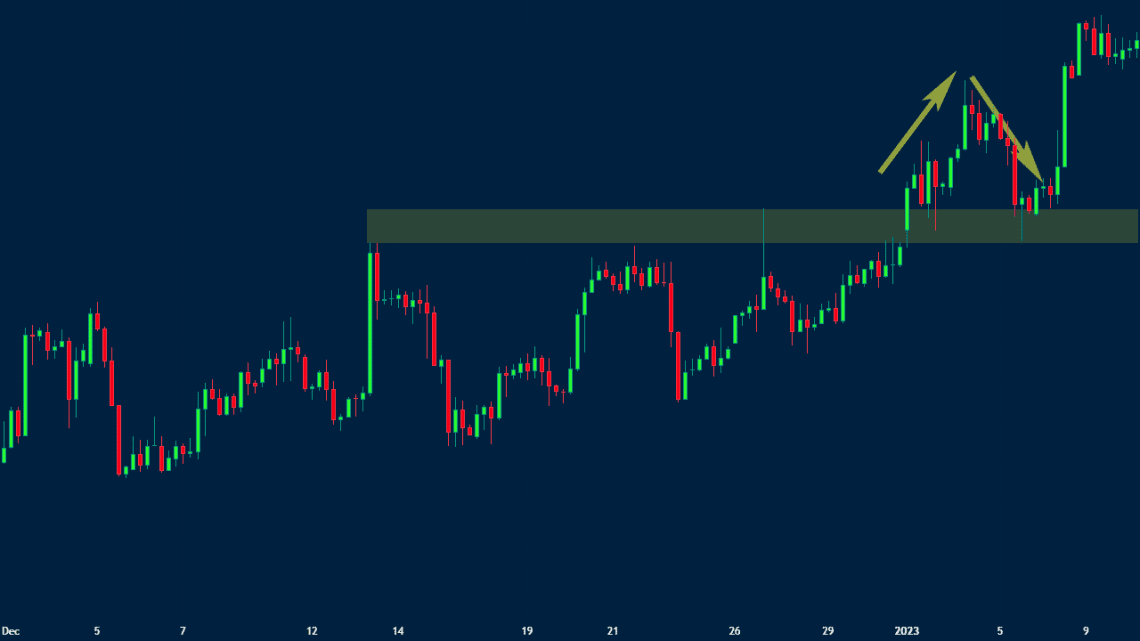
A first break tells you the price reached a level and passed it. That happens for several reasons, and only one of them is a genuine shift in control.
It also happens when a cluster of stops triggers and accelerates price briefly through thin liquidity, with nothing behind the move once that supply is gone.
A retest filters those out. If the level has genuinely flipped, price returning to it should find the opposite side of the order flow and turn away. If the break was a sweep, price returns and keeps going, and you were never in the trade.
So the retest removes a specific category of failure. That is a real improvement rather than a statistical illusion.
Win Rate Is Not the Objective
Here is where the claim needs completing.
You do not get paid in win rate. You get paid in expectancy across all the opportunities your strategy sees, and waiting for a retest means declining every move that never retests.
Work it through with numbers.
Suppose breakout entries win forty percent of the time, risking one to make three. Across a hundred signals that returns sixty units of risk.
Now suppose retest entries win fifty five percent with the same reward, which is a substantial improvement. Each trade taken is worth one and a fifth units rather than six tenths.
But you only take the ones that retest. If sixty percent of breaks retest, you take sixty trades and finish with seventy two units. Better than the breakout approach.
If only thirty percent retest, you take thirty trades and finish with thirty six units, which is considerably worse despite every individual trade being better.
Same win rate improvement, opposite conclusion. The deciding variable is the retest rate.
Measure Your Retest Rate
This is checkable and almost nobody checks it.
Take the levels your strategy breaks over a month on your instruments. Count how many produced a retest within your defined parameters and how many simply ran.
That percentage tells you whether waiting is profitable for what you trade. It varies considerably by instrument, timeframe and volatility regime, which is why a general answer does not exist.
A strategy on a trending instrument may see few retests and lose most of its edge by waiting. A range bound instrument may retest almost everything.
Define the Retest Before You Need To
Ambiguity here is what turns the rule into a preference.
How close must the price come to the level? Must it touch, or is a defined distance acceptable. How long does the retest remain valid before the setup is stale. What confirms the turn, since arriving at the level is not the same as rejecting it.
Write those down. A retest you recognise afterwards is not a rule you traded.
Conclusion – Why Waiting for the Retest Improves Win Rate
Why waiting for the retest improves win rate is answered by what it filters out, and that part is sound. Whether it improves your returns depends on how often the retest appears on your instruments, which is a number you can count in an afternoon. Higher win rate with fewer trades is not automatically better.
FAQ – Why Waiting for the Retest Improves Win Rate
1. Does waiting for a retest always improve results?
No. It improves win rate reliably and improves returns only if enough breaks retest. Measure the rate on your own instruments.
2. How many breaks typically retest?
It varies too much by instrument, timeframe and conditions for a general figure to be useful. Count it yourself over a month.
3. What counts as a valid retest?
Whatever you define in advance. Set the distance, the time window and the confirmation before trading it, or you will recognise retests only in hindsight.
We have helped thousands of traders reach funding at TTT Markets from account sizes of $5k upwards to $500k. Check out our programs.
Additional resources:
Understanding Retest Trading – Complete Beginner Guide | PulseTrackAI
Enter on the Breakout or Wait for the Retest? – Osiris Trader

 support@tttmarkets.com
  WhatsApp Support →


