How to Trade Pullbacks Instead of Breakouts
Both approaches trade the same move. They differ in where you get in, and that difference changes the arithmetic considerably.
How to trade pullbacks instead of breakouts is worth understanding as a trade off rather than an upgrade, because the pullback has a real cost attached to its advantages.
The Arithmetic Favours the Pullback
A breakout entry takes the position at the extreme of the move, with the logical stop behind the structure that was broken, some distance away.
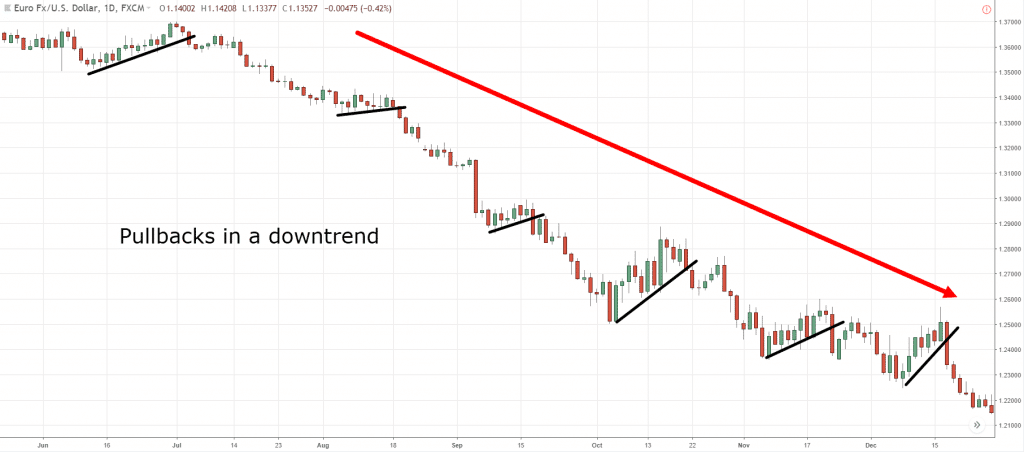
A pullback entry takes the same idea after price retraces, with the stop beyond the retracement extreme and closer to entry.
Same target, smaller stop, better reward relative to risk. That follows from where the entries sit rather than from opinion.
On a funded account the smaller stop has a second effect. Each attempt consumes less of your daily allowance, so you can be wrong more times before the limit matters.
False Breaks Are the Prop Problem
There is a more specific reason breakout trading is difficult on a drawdown limited account.
Breakouts fail frequently in ranging conditions, and failed breaks produce a recognisable pattern. A series of small losses, none individually alarming, across several sessions.
That never triggers a daily limit. It reaches the maximum loss limit instead, gradually enough that the trajectory is not obvious until the room left is uncomfortable.
Pullbacks do not remove losing trades, but the smaller stop means the same failures cost less room.
What the Pullback Costs You
The honest counterweight, because it is substantial.
Pullbacks do not always arrive. The strongest moves frequently run without retracing, and those are often the ones that travel furthest. A pullback trader waiting patiently misses them entirely.
So the two differ in participation rate. Breakouts get you into more moves with worse arithmetic, pullbacks into fewer with better. Which trade is worth making depends on your record rather than on general preference.
Most Pullback Entries Go Wrong at the Same Point
Entering on arrival at the level rather than on resumption.
A retracement reaching your level tells you price got there. It does not tell you the move is continuing, and a pullback that keeps going is simply a reversal you entered early.
Enter on evidence of resumption instead. A close back in the direction of the original move, a break of the retracement’s own minor structure, or whatever signal you can define and check. The specific trigger matters less than having one written down.
That wait costs you a portion of the move and removes most of the cases where the pullback was actually a trend ending.
Define All Four Parts
The trend condition. A pullback only exists inside something, so state what qualifies as a trend before you start looking for retracements within it.
The zone. Where the pullback is valid to. A structural level, a moving average, a retracement percentage. Pick one and write it down rather than deciding in the moment.
The trigger. What specifically initiates entry once price is in the zone.
The stop. Beyond the retracement extreme rather than at the level itself, since the level is precisely where price is expected to trade.
Then check the range remaining. A pullback late in a session may be structurally perfect with no room left for the resumption to reach target.
Conclusion – How to Trade Pullbacks Instead of Breakouts
How to trade pullbacks instead of breakouts comes down to accepting fewer trades in exchange for better arithmetic and less drawdown consumption per attempt. The entry that ruins it is arriving at the level and calling that a signal. Wait for resumption, define all four components in advance, and check there is still range available.
FAQ – How to Trade Pullbacks Instead of Breakouts
1. Are pullbacks better than breakouts?
Better arithmetic, lower participation. You miss the moves that never retrace, which are often the largest.
2. Where should the stop go?
Beyond the extreme of the retracement, not at the level itself. Price is expected to trade at the level, so a stop there gets hit by the setup working.
3. Why do my pullback entries keep reversing?
Usually because you entered on arrival at the level rather than on evidence the move was resuming.
We have helped thousands of traders reach funding at TTT Markets from account sizes of $5k upwards to $500k. Check out our programs.
Additional resources:
How Trading Market Pullbacks Instead of Breakouts Saved My Account

 support@tttmarkets.com
  WhatsApp Support →


